


Non-Compliance, Serious Breaches & Clinical Incidents
All non-compliance with the trial protocol, SOPs, Good Clinical Practice guidance/standards and applicable regulations, must be documented and in some cases, action taken to correct or prevent further non-compliance.
Documenting non-compliance and notifying the relevant stakeholders, is integral to protecting the participants of research and facilitating the generation of reliable results.
There are several documents that have been developed by different entities relevant to the conduct of clinical trials in Australia that describe requirements for documenting, reporting and acting upon non-compliance. This has resulted in some partial overlap in terminology and more than one stakeholder that may need to be notified for some categories of non-compliance depending on the trial setting, type of intervention, and if the non-compliance affects the safety of trial participants or the reliability of the trial data.
Non-compliance Terms used in Clinical Trials
A deviation is any breach, divergence, or departure from the requirements of Good Clinical Practice (GCP) or the clinical trial protocol.
This definition comes from the NHMRC Guidance: Reporting of Serious Breaches of Good Clinical Practice (GCP) or the Protocol for Trials Involving Therapeutic Goods (2018).
Protocol deviation is defined as “any change, divergence or departure from the study design or procedures defined in the protocol”.
This definition comes from the International Council for Harmonisation (ICH) guidance for industry E3 Structure and Content of Clinical Study Reports: Questions and Answers (R1)
At Melbourne Children’s this definition is expanded to include the following clarifying principles taken from TransCelerate: Protocol Deviation Process Guide:
· An actual event occurred (i.e. not theoretical).
· The event is related to the protocol or documents referenced in the protocol (e.g. laboratory manual).
· The event is independent of fault, blame or circumstance (e.g. participant refused a procedure, sample tube broke en route to the central laboratory).
Examples of protocol deviations include:
· Visit date outside the study visit window
· Missed or incomplete study procedure (e.g. lab test)
· A medical error eg a medication over/ under dose.
· Missed or incomplete study evaluation (e.g. assessment or examination)
A protocol deviation that may significantly impact the completeness, accuracy and/or reliability of the trial data or that may significantly affect a participant’s rights, safety or well-being.
This definition comes from the ICH Harmonised Guideline: Guideline for Good Clinical Practice E6(R3) which will be implemented in Australia under the auspices of the Therapeutic Goods Administration following broad stakeholder consultation. Anticipated implementation date is late 2025/early 2026.
Note Important Protocol Deviation is not defined in the current version of GCP adopted in Australia, Integrated Addendum to ICH E6(R1): Guideline for Good Clinical Practice ICH E6(R2) - Annotated with TGA comments.
The Sponsor is responsible for determining necessary trial-specific criteria for classifying protocol deviations as important and including this information in the trial protocol and trial-related training.
A serious breach is a breach of (deviation from) Good Clinical Practice (GCP) or the protocol that is likely to affect to a significant degree:
a) The safety or rights of a trial participant; and/or
b) The reliability and robustness of the data generated in the clinical trial.
This definition comes from the NHMRC Guidance: Reporting of Serious Breaches of Good Clinical Practice (GCP) or the Protocol for Trials Involving Therapeutic Goods (2018).
Important: If a serious breach is a breach of the protocol, it may also meet the criteria for an “Important Protocol Deviation”.
An event or circumstance that resulted, or could have resulted, in unintended or unnecessary harm to a person receiving clinical care or that is a client of a service. The term includes events or circumstances that occur during service delivery, resulting in harm or is reasonable likely to cause serious harm to a client.
This definition comes from the Victorian Health Incident Management System Minimum Data Set (VHIMS MDS) v2 manual 2024-25 available from https://vahi.vic.gov.au/ourwork/vhims-program-of-reforms.
Reporting & CAPAs
Refer to table below for reporting requirements for different types of non-compliance.
Further details about the Melbourne Children’s requirements for reporting non-compliance are found in the following campus procedures:
For Sponsor-Investigators:
For Site Principal Investigators:
· RCH Procedure: Incident, Injury and Hazard Reporting, available for download at https://www.rch.org.au/policy/public/Public_Policies_and_Procedures/
Note: Only applicable if non-compliance resulted in harm or is reasonable likely to cause serious harm to an RCH trial participant.
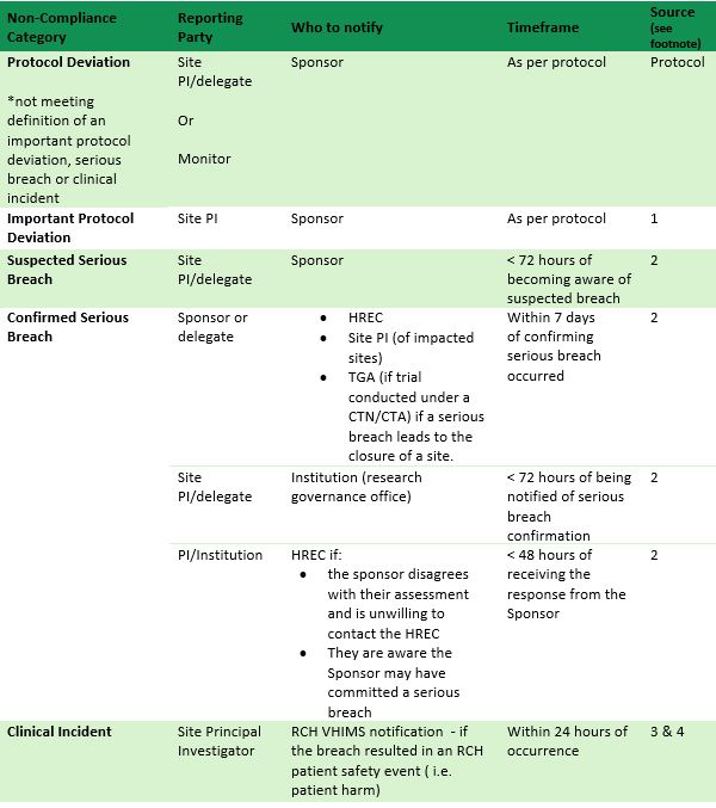
3. Victorian Health Incident Management System Minimum Data Set (VHIMS MDS) v2 manual 2024-25
4. The Royal Children’s Hospital Procedure (February 2025), Incident, Injury and Hazard Reporting. Available for download from The Royal Children’s Hospital Public Policies and Procedure library
Monitors/Auditors/Inspectors will usually require a corrective and preventive action plan (CAPA) to respond to non-compliance meeting definition of a serious breach.
Non-compliances found during audits and inspections are graded using three levels: critical, major and minor. The levels assess the severity and impact of the non-compliance in terms of:
· trial participants rights, safety and well-being
· quality/integrity of the trial data
· violation of applicable legislation and guidelines
The Monitor/Auditor/Inspector will set a deadline for provision of the CAPA and any urgent corrective actions required to protect the safety/well-being of trial participants.
One person should assume overall responsibility for completing the CAPA. For site CAPAs, this will usually be the Principal Investigator. For Sponsor/Sponsor-Investigator CAPAs, this person will be the appropriate Sponsor representative (Monitor or Auditor), depending on the type of non-compliance.
The party undertaking the monitoring/audit/inspection will provide the list of non-compliances in a CAPA plan and request the monitored/audited/inspected party to provide root cause, immediate corrective action and future preventative actions with timelines for completion.
MCTC061 SOP | Continuous improvement: A Corrective and Preventative Action (CAPA) Plan is to be used for developing and implementing a CAPA in response to non-compliance identified during internal monitoring/audit of RCH and MCRI at site level and internal auditing at Sponsor level. In this case, also use MCTC080 Template | CAPA Plan and MCTC081 Template | CAPA Tracking Log. Note these tools may also be used when RCH/MCRI staff have been delegated role of Monitor for external participating trial sites.
External parties involved in monitoring/audit/inspection will use their own CAPA procedure and templates for documenting findings and responses.
Inspections & Regulations
To understand the most common observed areas of non-compliance in clinical trials using medicine/device interventions, refer to past inspection program metrics reports from the Therapeutic Goods Administration (TGA), MHRA, EMA and FDA.
TGA Good Clinical Practice Inspection Program Metrics Reports
MHRA Good Clinical Practice Metrics Reports of Compliance Issues
Different regulatory requirements apply depending on the geographic location of the trial sites. MCRI Sponsor-Investigators are responsible for understanding the relevant regulatory framework under which they conduct their trials. The list below includes those relevant to trials conducted in Australia, the European Union and United States.